

.svg)
RESEARCH & INSIGHTS
Exploring the Economics of Space
SpaceVault champions off-planet economic expansion, centered on infrastructure and asset custody.
Orbital Infrastructure
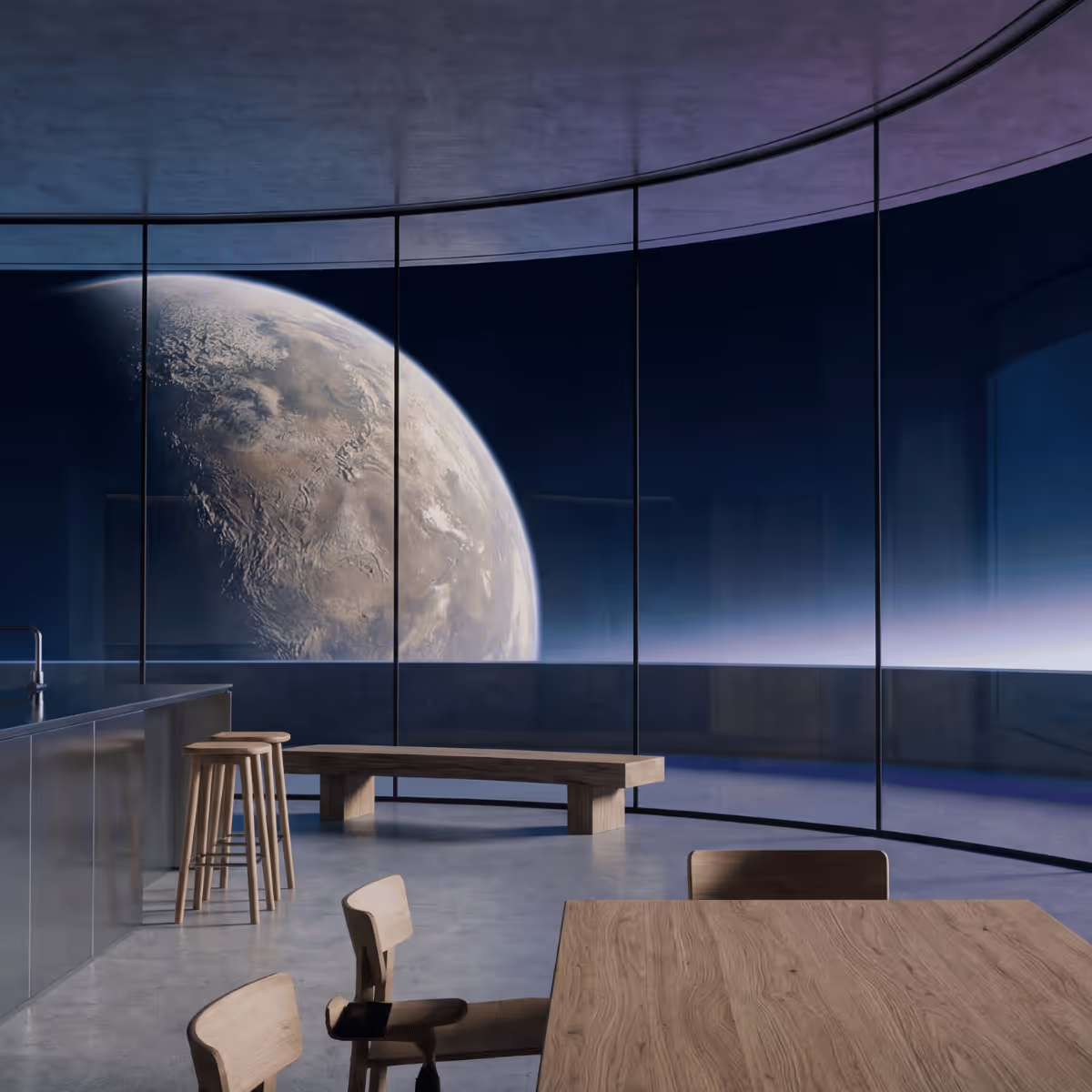
As activity expands into orbital environments, infrastructure will no longer be confined to terrestrial networks. Satellites, stations, and distributed systems may form the backbone of new economic layers operating beyond traditional jurisdictions.
Orbital infrastructure introduces redundancy at a planetary scale — reducing single points of failure and reshaping how continuity and risk are understood. The question is not only technological feasibility, but institutional design.
Orbital infrastructure introduces redundancy at a planetary scale — reducing single points of failure and reshaping how continuity and risk are understood. The question is not only technological feasibility, but institutional design.
Digital Custody Models
Digital custody has historically depended on legal territories, regulatory frameworks, and centralized institutions. As value becomes increasingly native to digital and distributed systems, these models face structural limits.
Future custody systems may need to operate across jurisdictions — or outside of them entirely. Designing secure, neutral, and durable frameworks for asset preservation will require rethinking trust, governance, and enforcement mechanisms from first principles.
Future custody systems may need to operate across jurisdictions — or outside of them entirely. Designing secure, neutral, and durable frameworks for asset preservation will require rethinking trust, governance, and enforcement mechanisms from first principles.
Neutral Economic Zones
Economic systems have historically been defined by geography and political boundaries. Neutral infrastructure challenges this model by enabling coordination independent of territory.
The core question: how can value remain stable when participation is no longer bound to physical borders?
The core question: how can value remain stable when participation is no longer bound to physical borders?

Orbital Infrastructure
Digital custody has historically depended on legal territories, regulatory frameworks, and centralized institutions. As value becomes increasingly native to digital and distributed systems, these models face structural limits.
Future custody systems may need to operate across jurisdictions — or outside of them entirely. Designing secure, neutral, and durable frameworks for asset preservation will require rethinking trust, governance, and enforcement mechanisms from first principles.
Future custody systems may need to operate across jurisdictions — or outside of them entirely. Designing secure, neutral, and durable frameworks for asset preservation will require rethinking trust, governance, and enforcement mechanisms from first principles.
Digital Custody Models
Digital custody has historically depended on legal territories, regulatory frameworks, and centralized institutions. As value becomes increasingly native to digital and distributed systems, these models face structural limits.
Future custody systems may need to operate across jurisdictions — or outside of them entirely. Designing secure, neutral, and durable frameworks for asset preservation will require rethinking trust, governance, and enforcement mechanisms from first principles.
Future custody systems may need to operate across jurisdictions — or outside of them entirely. Designing secure, neutral, and durable frameworks for asset preservation will require rethinking trust, governance, and enforcement mechanisms from first principles.
Neutral Economic Zones
Economic systems have historically been defined by geography and political boundaries. Neutral infrastructure challenges this model by enabling coordination independent of territory.
The core question: how can value remain stable when participation is no longer bound to physical borders?
The core question: how can value remain stable when participation is no longer bound to physical borders?


The Longevity Problem
Economic systems have historically been defined by geography and political boundaries. Neutral infrastructure challenges this model by enabling coordination independent of territory.
The core question: how can value remain stable when participation is no longer bound to physical borders?
The core question: how can value remain stable when participation is no longer bound to physical borders?
Infrastructure Beyond Borders
As economic activity expands beyond Earth, jurisdiction becomes less central. Infrastructure must operate across political and legal environments without losing coherence.
Durability will depend on neutral, interoperable design.
Durability will depend on neutral, interoperable design.
Resilience by Design
Resilience is engineered, not assumed. Long-term systems require redundancy, adaptability, and structural foresight.
Stability in future markets will depend on infrastructure built for continuity.
Stability in future markets will depend on infrastructure built for continuity.

The Longevity Problem
Modern systems prioritize efficiency. Generational preservation requires durability.
In multi-planetary environments, long-term value depends on infrastructure designed to withstand disruption — not just optimize performance.
In multi-planetary environments, long-term value depends on infrastructure designed to withstand disruption — not just optimize performance.
Infrastructure Beyond Borders
As economic activity expands beyond Earth, jurisdiction becomes less central. Infrastructure must operate across political and legal environments without losing coherence.
Durability will depend on neutral, interoperable design.
Durability will depend on neutral, interoperable design.
Resilience by Design
Resilience is engineered, not assumed. Long-term systems require redundancy, adaptability, and structural foresight.
Stability in future markets will depend on infrastructure built for continuity.
Stability in future markets will depend on infrastructure built for continuity.
RESEARCH AREAS
Key Areas of Exploration


Join the Early Community


